
Rim formation in complex impact craters
Rim formation in complex impact craters: field survey, remote sensing, and analogue modeling
Abstract
The structure and the morphology of complex impact craters are largely the result of the gravitational collapse of the so-called transient crater cavity, which forms during the excavation stage of an impact. The distinct elevation of the final crater rim, observed at many craters on Earth, Moon, and Mars, however, cannot be explained by either the gravitational collapse or the thickness of the ejecta blanket. This project is aimed at understanding the formation of elevated rims in complex impact craters and the mass movements that occur between the transient and final crater. The proposed investigation comprises three parts: field surveys, remote sensing, and analogue modeling. (i) Field surveys at the Ries and Jebel Waqf as Suwwan impact craters were selected, as their crater rim areas are well exposed, elevated, and display to-date not well understood reverse faults that could explain the rim uplift. (ii) The comparative investigation of the crater rim area of fresh Lunar and Martian complex impact craters utilizing high resolution remote sensing imagery enables a detailed measurement of rim elevations, terraces sizes, and displacements. Further goals are the localization of the transient crater, and the quantification of the effect of target volatiles on the formation and extent of the rim area. (iii) Scaled analogue experiments of crater formation and collapse provide a comprehensive understanding of the kinematic evolution of collapsed crater rims and will be compared to nature and numerical models.
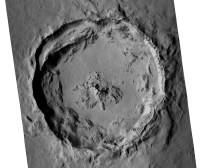
Complex impact crater with elevated rim and pronounced terracing, Tooting, Mars. Source: NASA
Prof. Dr. Thomas Kenkmann, Tim Krüger & Sebastian Sturm
Funding organization: DFG KE 732/21-1
Term: 01.03.2013 bis 01.03.2016
Cooperation partners:
Prof. Dr. Elias Salameh, University of Jordan, Amman
Dr. Jens Ormö, Centro de Astrobiologia, Instituto Nacional de Tecnica Aeroespacial, Madrid
Abstract
The structure and the morphology of complex impact craters are largely the result of the gravitational collapse of the so-called transient crater cavity, which forms during the excavation stage of an impact. The distinct elevation of the final crater rim, observed at many craters on Earth, Moon, and Mars, however, cannot be explained by either the gravitational collapse or the thickness of the ejecta blanket. This project is aimed at understanding the formation of elevated rims in complex impact craters and the mass movements that occur between the transient and final crater. The proposed investigation comprises three parts: field surveys, remote sensing, and analogue modeling. (i) Field surveys at the Ries and Jebel Waqf as Suwwan impact craters were selected, as their crater rim areas are well exposed, elevated, and display to-date not well understood reverse faults that could explain the rim uplift. (ii) The comparative investigation of the crater rim area of fresh Lunar and Martian complex impact craters utilizing high resolution remote sensing imagery enables a detailed measurement of rim elevations, terraces sizes, and displacements. Further goals are the localization of the transient crater, and the quantification of the effect of target volatiles on the formation and extent of the rim area. (iii) Scaled analogue experiments of crater formation and collapse provide a comprehensive understanding of the kinematic evolution of collapsed crater rims and will be compared to nature and numerical models.
Publications
Collins, G. S., Kenkmann, T., Osinski, G. R., and Wünnemann, K., 2008. Mid-sized complex crater formation in mixed crystalline-sedimentary targets: insight from modeling and observation. Meteoritics and Planetary Science 43, 12, 1955-1977.
Kenkmann, T. and Ivanov, B. A., 2006. Thin-skin delamination around impact craters: an example from the Ries crater, Germany. Earth and Planetary Science Letters 252 (1/2), 15-29.
Kenkmann, T., Reimold, W. U., Khirfan, M., Salameh, E., Khoury, H. and Konsul, K., 2010. The complex impact crater Jebel Waqf as Suwwan in Jordan: effects of target heterogeneity and impact obliquity on central uplift formation. In: Gibson, R. L. and Reimold, W. U. (eds.): Large Meteorite Impacts and Planetary evolution IV. Geological Society of America Special Paper 465, 471-487.
Poelchau, M. H., Kenkmann, T, and Kring, D. A., 2009. Rim uplift in simple craters: the effects of target heterogeneities and trajectory obliquity. Journal of Geophysical Research 114, E01006; doi: 10.1029/2008JE003235.
Kenkmann, T. & Burgert, P. (2011): Impact Crater Collapse: First Experimental Results from Analogue Modeling Using Particle Image Strainometry.- 42nd Lunar and Planetary Science Conference, March 7-11.2011. [#1511]
Sturm, S., Wilmes,M., Hiesinger, H., Kenkmann, T. & Pösges, G. (2011): Megablocks in the Ries Impact Crater, Germany: New Discoveries and Statistical Analysis of Distribution and Lithologies. - 42nd Lunar and Planetary Science Conference, March 7-11.2011. [#1705]